ice wedge
Link: http://w3id.org/permafrost/v/ipaglossary/t0167
Within: IPA Permafrost Glossary
Definition: A massive, generally wedge-shaped body with its apex pointing downward, composed of foliated or vertically banded, commonly white, ice (see Figure 17).
| Term |
coin de glace
fr
ice wedge en |
|---|---|
| Comment |
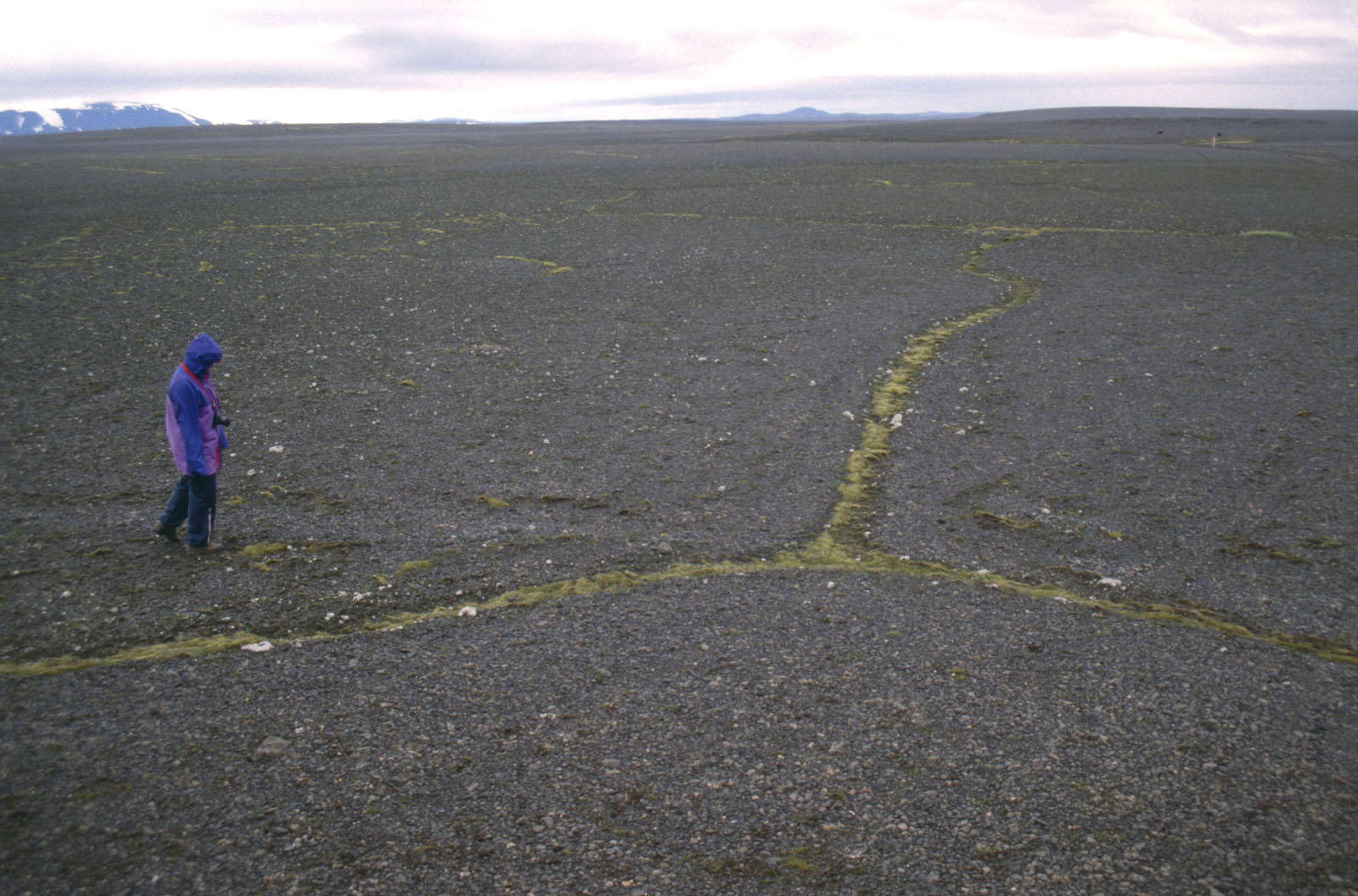
The size of ice wedges varies from less than 10 cm to more than 3 m in width at the top, commonly tapering to a feather edge at a depth of 1 to more than 10 m. Some ice wedges may extend downward as much as 25 m and may have shapes dissimilar to wedges. Epigenetic ice wedges are characteristically wedge-shaped, whereas syngenetic ice wedges and anti-syngenetic ice wedges are generally wedge-shaped but with more irregular sides (see also epigenetic permafrost, syngenetic permafrost). Ice wedges are formed in thermal contraction cracks in which hoar frost (see open-cavity ice) forms and into which water from melting snow penetrates in the spring. Repeated annual contraction cracking of the ice in the wedge, followed by freezing of water in the crack, gradually increases the width (and possibly the depth) of the wedge and causes vertical banding of the ice mass. The surface expression of ice wedges is generally a network of polygons. Ice wedges growing as a result of repeated (but not necessarily annual) winter cracking are called active ice wedges. They occur primarily in areas of continuous permafrost when developed in mineral soil. Inactive ice wedges can be stable and remain for many centuries without changing.
en
|
| References |
J. Ross Mackay. The frequency of ice-wedge cracking (19671987) at Garry Island, western Arctic coast, Canada. Canadian Journal of Earth Sciences. 29(2): 236-248. https://doi.org/10.1139/e92-022
ns1:ppp.523 |
| dcterms:source |
https://doi.org/10.4224/20386561
xsd:anyURI
|
| Image |

|
| Other images |

|